
Hoarding Cleanout Process: Discreet Help for Omaha Families
What actually happens from the first phone call to the final walkthrough, how to keep the job private on a close-knit block, and how to tell a careful crew from a fast one.
- A hoarding cleanout is a sorting job, not a hauling job — the timeline is set by decisions, and a crew that rushes them costs you trust you cannot get back.
- Junk removal companies cannot legally haul biohazards, chemicals, or asbestos. Contaminated properties need a licensed remediation contractor working alongside the cleanout crew.
- Discretion is logistics: where the truck parks, which door gets used, whether loads are covered, and how the schedule is split.
- Forced cleanouts backfire. Harm reduction — clearing exits and keeping heat sources free first — holds up better than clearing everything at once.
- Insist on an on-site walkthrough and a written scope. Firm phone pricing on a hoarding job is unreliable by definition.
- Physical cleanup alone rarely lasts without treatment and simple maintenance routines behind it.
In This Guide
- Why Hoarding Cleanouts Are Different
- What a Crew Handles, and What Needs a Specialist
- The Hoarding Cleanout Process, Step by Step
- Keeping the Job Discreet in an Omaha Neighborhood
- How to Choose a Hoarding Cleanout Service
- Omaha Timing and Access Issues
- After the Cleanout: Keeping the Space Livable
- Frequently Asked Questions
Most families do not call about a hoarding cleanout until something forces the issue. A fall. A failed inspection. A landlord notice. A parent who cannot reach the back bedroom anymore. By then the question is rarely should we do this and almost always how do we do this without making things worse. The honest answer is that a hoarding cleanout is not a bigger version of a junk pickup. It is a sorting project with a person attached to every item in the house, and the pace is set by that person, not by the truck. What follows is the practical version — what happens at each stage, what any junk removal company can and cannot legally do, and how to keep the whole thing off the neighborhood grapevine.
Why Hoarding Cleanouts Are Different
A standard junk removal job in Omaha is a volume problem. You point at the pile, the crew loads it, the truck leaves. A hoarding cleanout is a decision problem, and the decisions belong to someone who finds them genuinely painful to make.
The Emotional Side Is the Whole Job
Hoarding disorder is a recognized mental health condition, not messiness and not laziness. The American Psychiatric Association describes it as persistent difficulty parting with possessions because of a perceived need to save them. That framing matters in Omaha, where a large share of these calls involve an aging parent in a house they have lived in for forty years.
Two things follow. First, items that look like trash from the doorway often carry real meaning to the person who kept them, which is why a crew that starts bagging without asking will destroy trust in about ten minutes. Second, many people living with hoarding disorder do not see the situation the way their family does, so an approach built on convincing them tends to stall before the first load.
This is also why forced cleanouts have a poor track record. Clearing a house against someone’s will is distressing, and the clutter frequently returns when the underlying condition is not treated. Experienced teams work from a harm reduction mindset instead: deal with the dangerous conditions first, keep the person in control of the choices, and accept that a house does not have to be empty to be safe.
The Physical Hazards Are Real
The safety picture in a heavily cluttered home is different from a cluttered garage. Pathways narrow, floors disappear, and exits get blocked — a problem both for the people inside and for firefighters trying to get in.
Those first two figures come from the American Psychiatric Association and the U.S. Fire Administration. The three-foot clearance gets hard to maintain in a full house and much harder during a Nebraska winter when space heaters come out. Beyond fire, expect some mix of dust, pest activity, moisture, and odor, and be prepared for structural surprises once the floor is visible again — weight and unnoticed leaks do quiet damage over years.
- Standing water, soft flooring, or visible mold across a large area
- Animal waste accumulation, or a strong ammonia smell on entry
- Dead animals, needles, or human waste anywhere in the home
- Sagging ceilings, or floors that flex underfoot
- Anyone with asthma, COPD, or a compromised immune system still living in the space

What a Crew Handles, and What Needs a Specialist
This is the part most articles skip, and it is the part that saves families a wasted appointment. Junk removal companies and biohazard remediation contractors are two different businesses with two different sets of licensing. A good provider tells you plainly which one you need.
Room-by-room sorting alongside the household, all heavy lifting and stairs, furniture removal and appliance removal, donation pickup, recycling, responsible disposal, and full property cleanouts including attics and basements and garages.
Medical waste and sharps, dead animals, asbestos and radioactive material, liquid paint, solvents, motor oil and paint thinners, propane tanks, gas cylinders, freon tanks, batteries, plus large-area mold remediation and structural repair.
That second column is not a Midwest Removal quirk. Insured, locally compliant haulers cannot legally take hazardous materials, and the full list is published on the Things We Don’t Pick Up page. In practice, most hoarding cleanouts in Omaha are ordinary household volume with a few isolated problem spots, and the workable plan is usually a remediation contractor for those spots and a hoarding cleanout crew for everything else.
Rule of thumb: if a company promises to handle absolutely everything in a severely contaminated home, ask which of those services they are licensed for. A clear boundary is a sign of a company that knows the rules, not a company that cannot help.
The Hoarding Cleanout Process, Step by Step
Every property is different, but the sequence below is what a careful cleanout looks like from the outside. Knowing it in advance takes a lot of the dread out of the first call.
The First Conversation
Expect questions about how many rooms are affected, whether pets live in the home, whether there is known mold or pest activity, who is authorized to make decisions, and whether a deadline is driving the timing — a closing date, an inspection, an eviction notice. Say up front if privacy is a concern. It changes how the job gets scheduled.
The Walkthrough and Written Scope
Nobody can price this accurately over the phone. An on-site visit establishes volume, access, stair count, parking, hazards, and the rooms that need the most time. It is also the moment to point out the emotional hot spots — the closet of a late spouse, the boxes of family photographs — so the crew plans extra care there instead of discovering it mid-load.
Setup Before Anything Moves
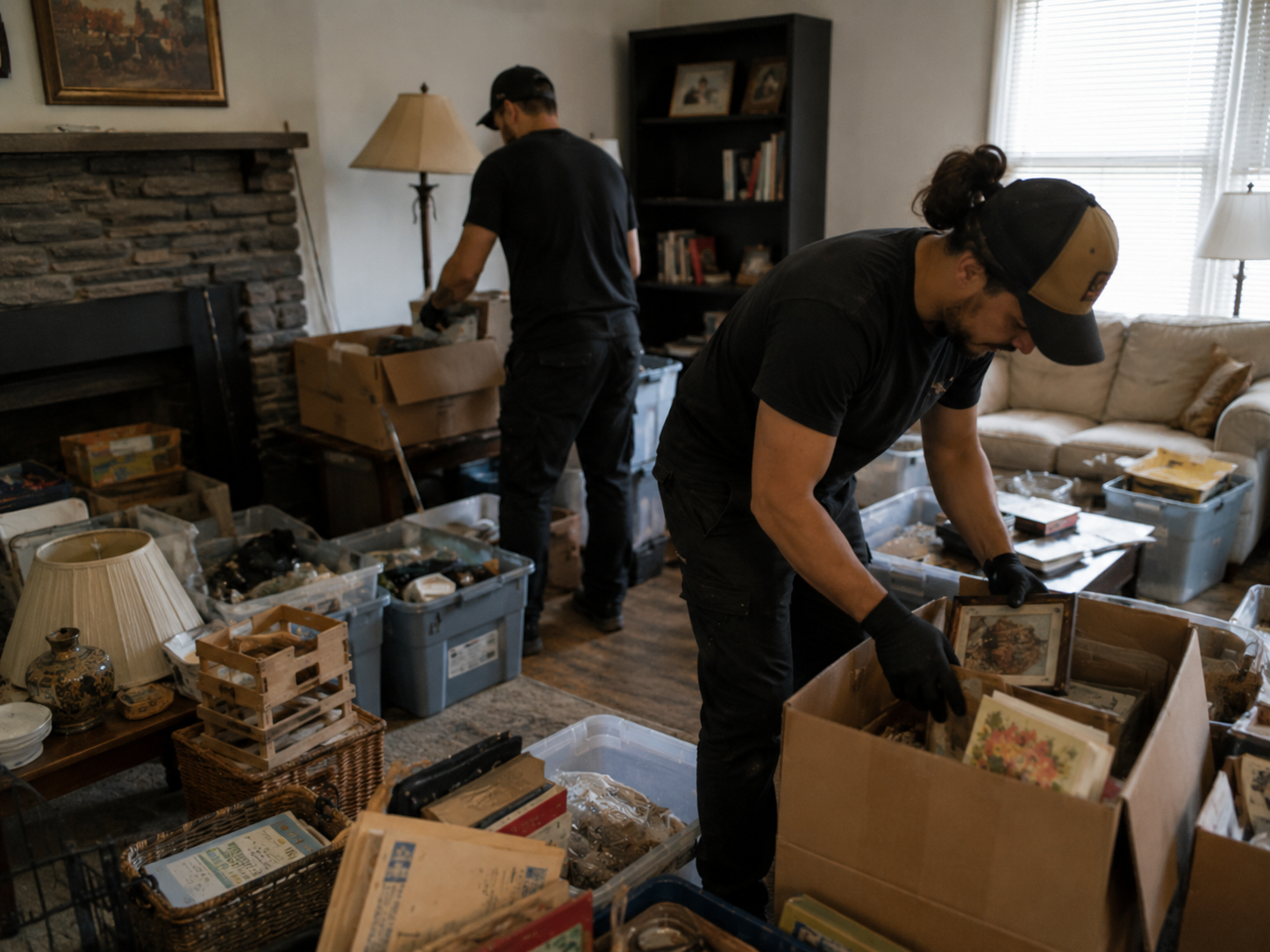
Crews arrive with gloves, masks, sturdy boots, and eye protection, lay down floor and doorway protection, and establish a staging area for sorting. Work usually starts in a lower-stakes room such as a bathroom, hallway, or entryway. Clearing a path to the exits early makes the house safer immediately and shows visible progress on day one, which matters more than people expect.
Sorting, Item by Item
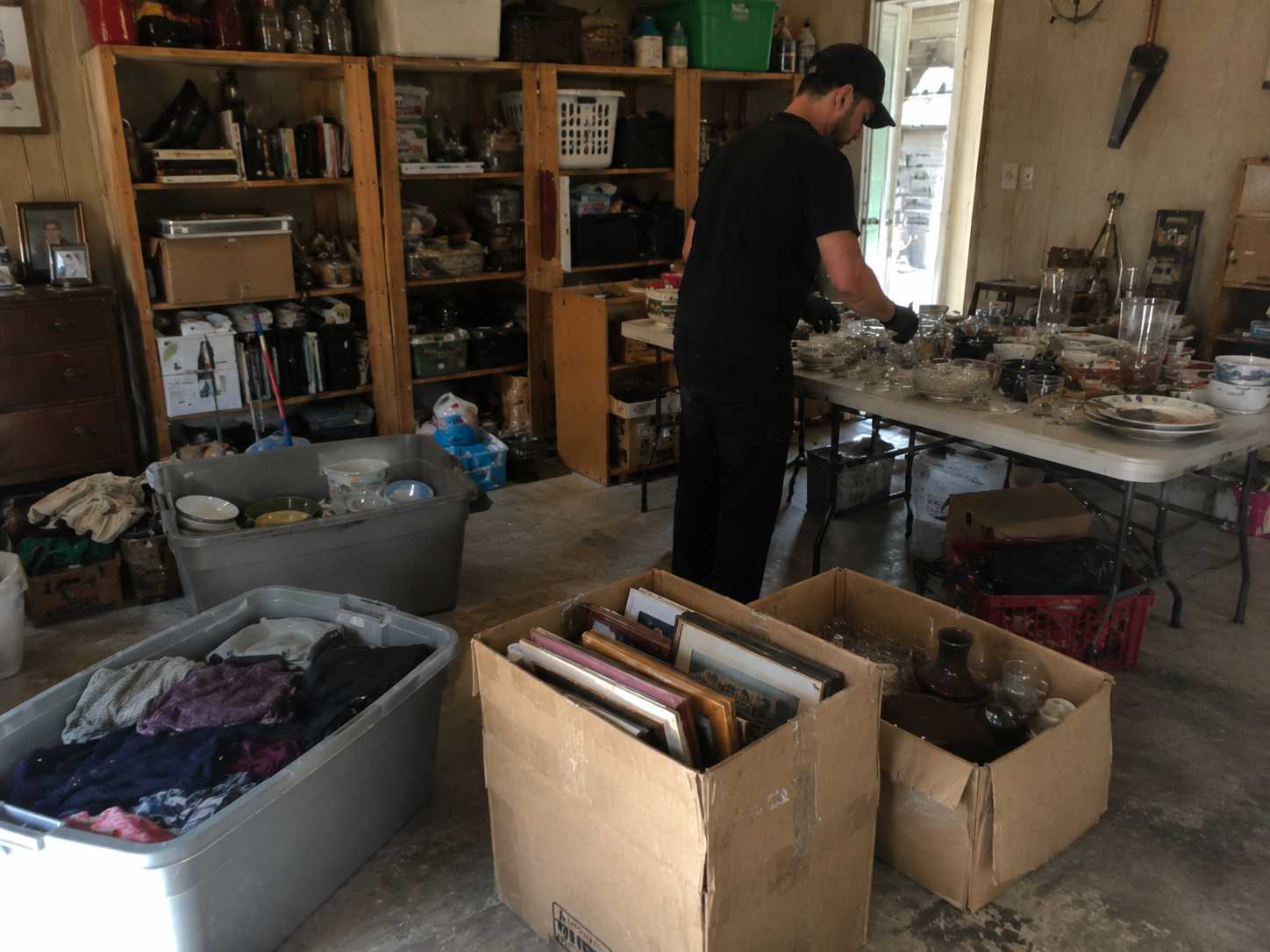
Items get grouped into keep, donate, recycle, dispose, and review. That last category separates a good crew from a fast one: anything the household is unsure about goes into a hold pile rather than onto the truck, to be revisited when nobody is exhausted. Crews check inside containers, coat pockets, books, and furniture before disposal, because cash, jewelry, deeds, and insurance paperwork turn up in strange places.
Donation, Recycling, Disposal
Usable goods are routed to charity, metal and cardboard and electronics go to recycling, and the remainder goes to disposal under Omaha waste rules. On multi-day jobs, loads leave as they fill rather than piling in the yard, which is better for both the neighbors and the household.
The Final Walkthrough
Walk every room together against the original scope. Confirm the hold pile is where it should be, note anything that turned up needing a different trade such as flooring or plumbing, and collect the paperwork you need for a landlord, an estate file, or an insurer.
Keeping the Job Discreet in an Omaha Neighborhood
Privacy is the concern families raise most, and it is usually less about secrecy than about not becoming the topic of the block. Discretion in practice is mostly logistics, and the details are worth negotiating before the first truck arrives.
- Where the truck parks. A driveway or alley is far less conspicuous than a full-size truck at the curb. Many older Omaha neighborhoods — Dundee, Benson, Field Club, Florence — have rear alley access that keeps the whole operation off the street.
- Which door gets used. Loading through a garage or back entry attracts much less attention than a front door propped open for eight hours.
- How loads are covered. Ask whether items are tarped or contained in transit rather than stacked in open view.
- What the crew says. Agree in advance on the answer if a neighbor asks. Midwest Removal crews do not discuss customer situations with anyone outside the household.
- How the schedule is broken up. Splitting a large job across separate days is often less visible than one long day of continuous truck traffic.
- Who else is on the property. If a relative is coordinating on behalf of a parent, decide who is present and who is not before the day arrives.
Midwest Removal runs Monday through Friday, 8am to 5pm, so plan discretion around access and staging rather than around after-hours work. Same-day and next-day appointments are often available, which helps when an inspection or closing date is driving the timeline.
How to Choose a Hoarding Cleanout Service
The gap between companies in this category is wide, and it is mostly a gap in patience. Use these questions on any provider, including this one.
- Are you insured, and can I see proof? General liability and workers compensation are the baseline. A reputable company sends documentation without hesitation.
- Will you quote in writing after seeing the property? A firm phone quote on a hoarding job is a warning sign, not a convenience.
- What happens to something I am unsure about? The right answer involves a hold pile, not a judgment call by the crew.
- How do you handle materials you cannot legally haul? You want a specific answer and, ideally, a referral.
- Where do donations and recyclables go? This separates sorting from truck-filling.
- Can you work around a family member who needs breaks? Hesitation here tells you how the day will actually go.
- Have you done occupied homes, not just estates? A cleanout with the resident present is a different job than an empty property.
For budget planning, the cost side has its own guide: hidden costs you will face when cleaning a hoarder house covers the expenses that surface after the clutter is gone. What an all-inclusive quote covers is explained on the pricing page, and common service questions are answered on the FAQ.
Omaha Timing and Access Issues
Local conditions change how these jobs run more than people expect.
Winter Is the Hard Season
Ice on walkways and steps is the main constraint from December through February, and it slows a crew carrying awkward loads. Salt and slush make floor protection non-negotiable. The upside of winter work is that blocked furnace access, blocked dryer vents, and clutter stacked near space heaters are exactly the hazards that matter most in a Nebraska cold snap, so clearing them has immediate value.
Spring and Summer
Upper floors and attics in Omaha’s older housing stock get brutally hot by mid-morning in July, so those rooms are worth scheduling first thing. Spring storm season is also when families discover roof and moisture damage that clutter had been hiding.
Access in Older Homes and Rentals
Narrow stairwells, steep basement stairs, and walk-up apartments without elevators all add time. Almost every Omaha house has a basement, and that is usually where the deepest accumulation sits, so budget an extra day before building a schedule around square footage alone.
If the property is a rental or part of a portfolio, the closer fits are apartment cleanouts, eviction cleanouts, and property management services. When a cleanout follows a death in the family, see estate cleanouts; for a move into care, see senior housing cleanouts and assisted living cleanouts. For the general sequence on any property, our step-by-step home cleanout guide covers it, and coverage across the metro is listed on the Omaha, NE service area page.
After the Cleanout: Keeping the Space Livable
An empty room is a starting point, not a finish line. The two things that make the result stick are small maintenance routines and, where hoarding disorder is involved, actual treatment.
Routines That Hold Up
Keep them boring and specific. Trash to the curb on a set day. Mail sorted where it enters the house, daily, standing up. One in, one out for categories that tend to multiply. A short reset once a month rather than a marathon twice a year. The goal is a home that functions, not a magazine spread — setting the bar at perfection is the fastest way to abandon the whole effort.
Treatment and Support in the Omaha Area
Cognitive behavioral therapy adapted for hoarding is the best-supported treatment, and it works best with a therapist who has specific experience in it. Cleanup addresses the environment; therapy addresses the reasons the environment got that way. These starting points are free to contact:
- Region 6 Behavioral Healthcare coordinates publicly funded behavioral health services for Douglas, Sarpy, Cass, Dodge, and Washington counties. 402-444-6573 or 800-311-8717.
- Behavioral Health Connection through Nebraska Medicine helps adults and families find and get to appropriate services at no charge. 402-836-9292.
- Nebraska Network of Care lists regional providers. Text the word Find to 402-788-4141.
- International OCD Foundation maintains a hoarding resource directory and family education materials at iocdf.org.
- 988 Suicide & Crisis Lifeline is available 24/7 by call or text if a family member is in crisis.
If the person living in the home is not ready, that is common and it is not the end of the conversation. Start with the hazards that matter most, keep the exits and heat sources clear, and let the rest follow treatment rather than trying to lead it.
For families coordinating from out of town: you do not have to run this alone from another state. Midwest Removal can walk the property, put a scope in writing before anything moves, and keep one relative as the single point of contact. Request a quote or call (402) 318-5241 to talk it through first.
Frequently Asked Questions
This guide is general information for Omaha-area families, not medical or legal advice. Midwest Removal is a junk removal and property cleanout company, not a mental health provider or a licensed biohazard remediation contractor. Fire safety guidance referenced above comes from the U.S. Fire Administration.
Get a Free Quote from Midwest Removal
Discreet hoarding cleanouts across the Omaha metro — sorting, lifting, hauling, donation, and recycling handled by one crew. Family owned, licensed and insured, with an upfront quote before any work begins.
Request a Free Quote